Delhi Metro Rail 2026: Complete Guide with Routes, Timetable, Fares, Latest Updates, Facts & FAQs
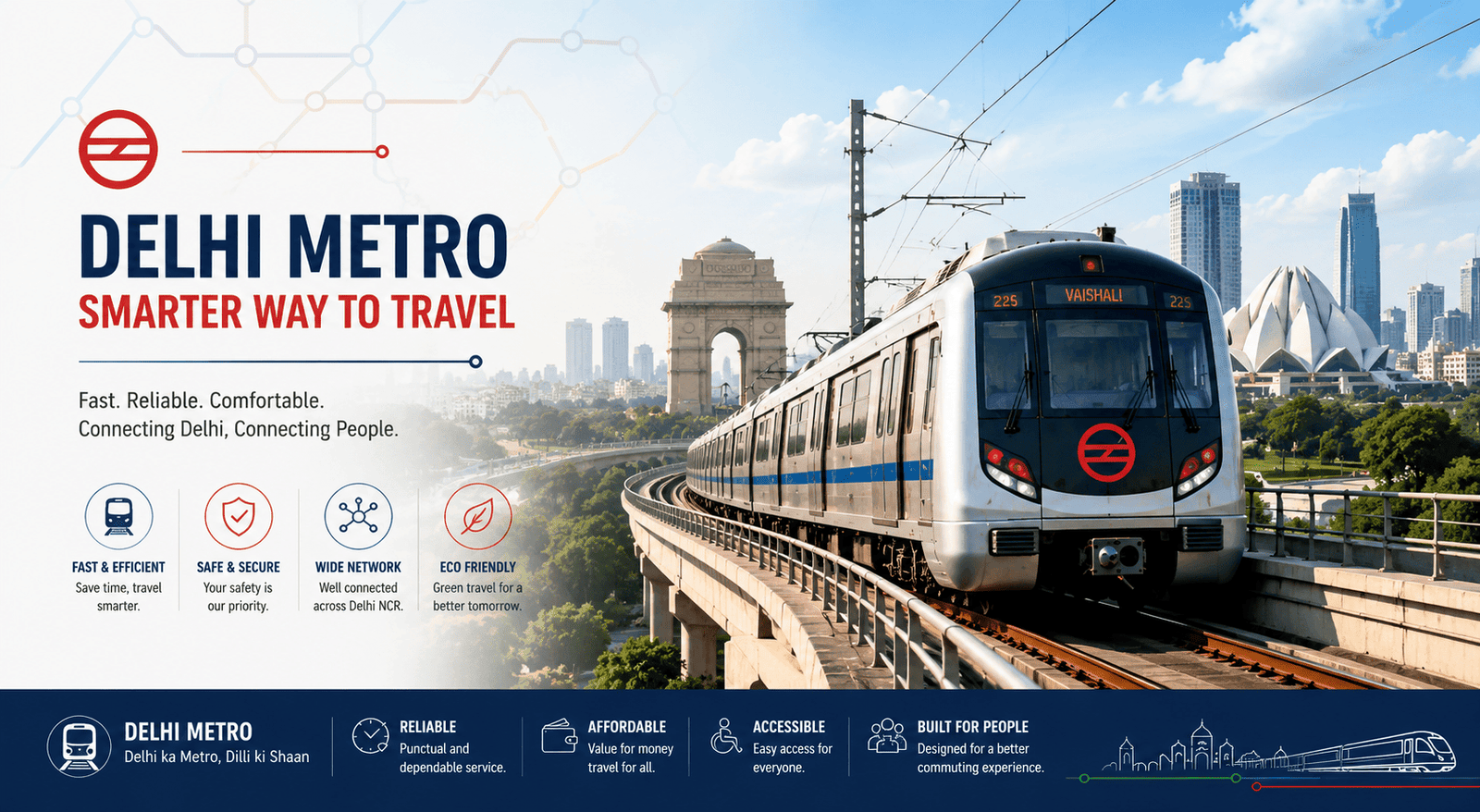
Delhi Metro Railway is the biggest, busiest, and most effective urban rail system network in India. By mid-2026, it becomes the backbone of public transportation for the National Capital Region(NCR), linking Delhi to Noida, Gurgaon, Ghaziabad, Faridabad, and other near by places.
Delhi Metro Rail: Overview & Latest Statistics (2026)
- Total Network Length: It has approximately 416 kms including extensions and associated lines like Aqua Line.
- Number of Stations: It has 303 metro stations across 12 lines.
- Daily Ridership: Daily around 4.6 – 6.5 million passengers travel through Delhi Metro Rail & on peak days can exceed 8 million passengers .
- Lines: 10+ colour-coded lines and Airport Express.
- Operator: Delhi Metro Rail Corporation (DMRC).
The network consists of a combination of underground, elevated, and surface segments along with tracks in both broad and standard gauges. Most of the lines (Pink & Magenta) are already working on an unmanned basis.
Major Lines in Delhi Metro
| Line Colour | Name | Key Route | Approx. Length | Stations |
|---|---|---|---|---|
| Red | Red Line | Dilshad Garden – Rithala | ~35 km | 25+ |
| Yellow | Yellow Line | Samaypur Badli – HUDA City Centre | ~45 km | 35+ |
| Blue | Blue Line | Dwarka Sec 21 – Noida Electronic City / Vaishali | ~55+ km | 50+ |
| Green | Green Line | Inderlok / Kirti Nagar – Brig. Hoshiyar Singh | ~30 km | 20+ |
| Violet | Violet Line | Kashmere Gate – Raja Nahar Singh | ~25+ km | 20+ |
| Pink | Pink Line | Majlis Park – Shiv Vihar / Maujpur-Babarpur | 70+ km | 38+ |
| Magenta | Magenta Line | Janakpuri West – Botanical Garden | ~40+ km | 25+ |
| Grey | Grey Line | Dwarka – Dhansa Bus Stand | ~5+ km | Few |
| Airport Express | Orange Line | New Delhi – Dwarka Sec 21 / Yashobhoomi | ~23 km | 6-8 |
(Recent additions in 2026 include extensions on Pink and Magenta lines opened in March 2026.)
Delhi Metro Rail: Latest Updates
- Phase IV Developments: Some critical segments started functioning in March 2026, which include Majlis Park-Maujpur-Babarpur (Pink Line) and others. Additional segments to be opened till the end of 2026.
- Phase 5A Approval: New corridor stretching for 16 km with 13 stations (underground) is approved to increase the length of the network beyond 400 km soon.
- Increased Driverless operations segments.
- Highest ridership days with added services during festivals.
- Focus on sustainability: Solar energy, emission reduction, improved last mile connectivity.
Delhi Metro Fares (2026)
Fares are distance-based and affordable:
- 0–2 km: ₹10–11
- 2–5 km: ₹20–22
- 5–12 km: ₹30–33
- 12–21 km: ₹39–43
- 21–32 km: ₹49–54
- 32+ km: ₹58–64
- Airport Express Line: ₹60–₹100+ depending on distance. Smart Card users get 10% discount. Off-peak discounts (MJQRT) of 20% available on select timings. Tourist cards and daily passes are also available.
Timetable – First & Last Trains
Standard Operating Hours: Approximately 5:00 AM – 11:00/11:30 PM (varies slightly by line and day).
- First Trains: Usually between 5:00 AM – 6:00 AM from terminals.
- Last Trains: Around 10:45 PM – 11:30 PM (terminals may run later).
- Frequency: 2–4 minutes during peak hours (8–11 AM & 5–9 PM), 5–10 minutes otherwise.
- Airport Express and some lines may start earlier (~4:45–5:00 AM).
Tip: Make sure to check the DMRC’s official website or app (delhimetrorail.com) for updated information regarding timings as they may differ due to events/festivals
How to Travel – Practical Tips
- Ticketing: Use Smart Cards, QR codes via app, UPI, token.
- Apps: Always make sure you are dfficial DMRC app, Delhi Metro Route apps for live status and route planning.
- Safety: for assuring safety there is ladie’s coaches, CCTV, security. Platform screen doors on many stations.
- Accessibility: Smartly managed accessibility elements including Lifts, ramps, and dedicated facilitie.
- Peak Hours: Avoid peak hours if possible for a comfortable ride.
Benefits of Delhi Metro
- Reducing traffic congestion and pollution (claimed to have reduced lakhs of tons of pollution).
- High speed, punctuality, air conditioned, and affordable.
- Promoting economic development and raising property values along routes.
- Connecting important tourist places, office complexes, airports, and residential areas.
Conclusion
The Delhi Metro not only serves as a transportation facility but it is an emblem of a sustainable India. Be it a regular commuter, a tourist or a visitor, it provides you with the fastest and the easiest means of transport within the NCR.